
A brief history of indentured servitude
From the immigrant laborers of the 1600s to the educated class of the 21st century

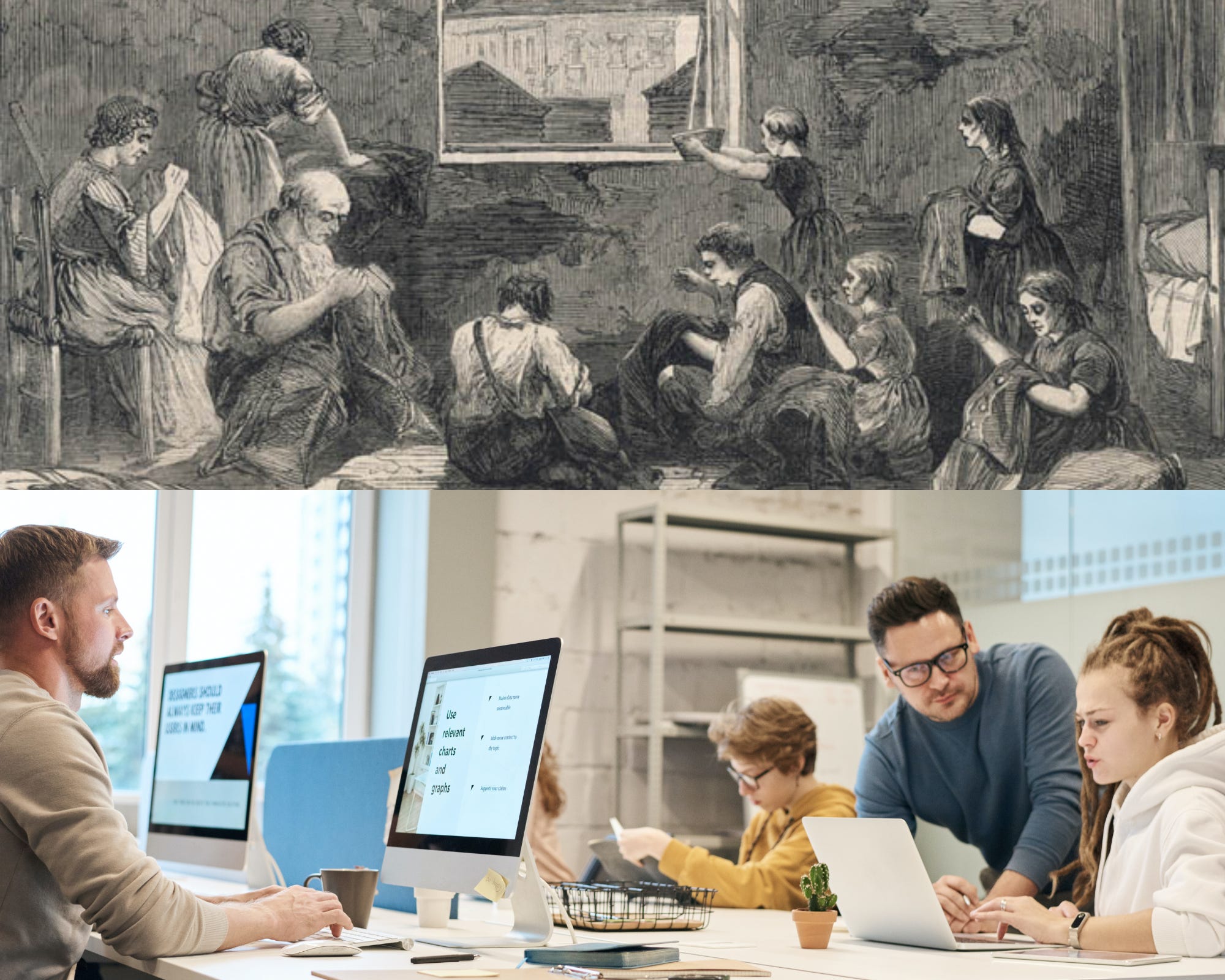
The People’s Radio - Official Transcript
Published June 23, 2079
Hello dear listeners.
Today on our show we are going to be exploring a brief history of indentured servitude. Our look into the misfortunes of these men and women will span the earliest immigrants of this country all the way through the fascinating case of the educated working class of the 2020s.
The subjects of this dreadful practice had much in common over the years, but with one key difference: for servants in the 1600s, servitude was a necessity. For their modern counterparts, it was a choice.
But why?
How could generations of people choose a life of servitude over freedom?
As you will soon learn, the Why and How that contributed to their plight were important—but not as important as the Who.
The Why
Indentured servitude began as a way to commit to labor for a specified duration of time in exchange for the necessities of survival and the promise of freedom.1
This practice first began in 1600s colonial America.2 It was eventually replaced by slavery, which slowly transitioned back into new flavors of servitude that capitalized on market demands created by the industrial revolution of the late 1700s and the technological revolution of the 21st century.
The indentured servants of the 21st century looked a little different than their early ancestors. Instead of being unpaid servants who did labor in exchange for housing, clothing, and food, they were paid in green pieces of paper, the currency of the time, which they exchanged for housing, clothing, and food.
Hundreds of millions of Americans existed during this period. Among them, only a select few were able to evade servitude. This was achieved either by generating abundant wealth or finding a vocation for which they cared deeply.
As fate would have it, the overwhelming majority would not be so lucky.
The How
In its earliest phases, those who entered into an agreement of indentured servitude did so to fulfill the need for cheap manual labor. As technology continued to evolve in the early 2000s, the working conditions did as well.
However, the work itself often left much to be desired.
Many days were occupied with trivial tasks that provided little satisfaction. Weeks of labor so draining that servants lacked the energy to make any use of their nightly reprieves. Months that contained glimmers of hope. Years spent toiling in various offices for various masters. Decades devoted to tedious jobs that fueled the growth of the institution, but not the man.
Entire lives could be defined by the brand of servitude one undertook.
Many preferred to avoid confronting these realities. It was a common practice to publicly profess love for a career one secretly loathed. To conflate one’s personal identity with the one their master handed them in early adulthood.

Thanks to the advent of freelance marketplaces and tremendous access to knowledge and money via the internet, professionals of this era had the rare opportunity to build a lifestyle suited to their specific wants and needs.
But this path was far less popular.
More than loss of economic stability, it was the potential for public failure that plagued the minds of these people. But where did this fear come from? What were the forces preventing them from pursuing something more gratifying?
Enter: The Masters of Society
The Who
Throughout history, members of nearly all civilizations worshipped those with wealth and power. The educated class of the 21st century was no different.
What made this situation unique was that not only did this worship elevate the status of the societal elite, but it led to something far more powerful than that of forced labor: cultural influence. As a result, the wealthy and political elite who owned and operated society did so with unprecedented leverage.
This ownership came with numerous responsibilities, but none more important than incentivizing workers to keep their minds on the benefits of labor and off of those pertaining to freedom.
These incentives came in many forms.
The Masters of Society curated social hierarchies and reward systems that placed a higher value on job title than autonomy. On attaining luxury instead of stability. On the pursuit of status over happiness.
These motivating forces worked to subtly align the goals of the servant with those of the master—and they worked as intended.
After all, there was a comfort in this type of arrangement.
One that came at quite the cost.
The cost of freedom
In the initial stages of the practice, laborers would typically agree to a contract length of around 5 years.3 Approximately 2/5 of these colonial servants would die before completing their terms. Those who survived would go on to enjoy humble yet long remainders of life.
In the 20th and early 21st century, the age of 65 was the popularly accepted term when the contractual obligations of servitude would be fulfilled. This meant that, on average, members of this white collar class would enjoy a mere 13 years of freedom before dying in their late 70s.
Savants of manipulation and artisans of human incentive, The Masters of Society were able to get the best and most valuable decades from these individuals in exchange for freedom in their least productive, least mobile, and least rewarding years.
A brutal tradeoff of 40+ years spent serving their masters for a brief period of sovereignty—one that often consisted of little more than some light travel amidst rapid decay.
Present day
It wasn’t until the late 2020s that the harsh practice of indentured servitude finally came to an end. With the demise of the corporate structure and transition to a completely decentralized world, we are now able to be compensated through the fruits of our creative labors and provide for ourselves without the burden of masters.
When you look at the current shape of the collective economy and the personal freedoms it—whoops, I’m being told to wrap it up.
Parting thoughts
Once again, thank you all so much for listening. I’ll leave you with this:
Human life is short.
Despite advancements that allow us to maintain consciousness in other forms, the most visceral and rewarding moments in life cannot be sustained. Those who spent their best years in servitude experienced only fragments of such moments.
While the terms and labor have changed throughout history, the mechanisms of servitude have not. The difference, it seems, is the desire for liberation.
Actualized enough to seek it.
Fearless enough to pursue it.
So for the men and women who occupy this dubious place in our history, how did their stories end?
Whether consciously or not, most decided to remain indentured.
Just a few chose freedom.
“Indentured Servants in the U.S. | History Detectives.” PBS, Public Broadcasting Service, https://www.pbs.org/opb/historydetectives/feature/indentured-servants-in-the-us/.
Wolfe, Contributor: Brendan. “Indentured Servants in Colonial Virginia.” Encyclopedia Virginia, 1 June 1349, https://encyclopediavirginia.org/entries/indentured-servants-in-colonial-virginia/.
“Indentured Servants.” Ushistory.org, Independence Hall Association, https://www.ushistory.org/us/5b.asp.